Contents
- Healthcare Infrastructure
- Medical Education & Research
- A G Unani Medical College
- Age Old Practices & Remedies
- NGOS & Initiatives
- Lakshya 84 Days
- COVID Stories
- Chinchpada Hospital
- Nandurbar Model
- Graphs
- Healthcare Facilities and Services
- A. Public and Govt-Aided Medical Facilities
- B. Private Healthcare Facilities
- C. Approved vs Working Anganwadi
- D. Anganwadi Building Types
- E. Anganwadi Workers
- F. Patients in In-Patients Department
- G. Patients in Outpatients Department
- H. Outpatient-to-Inpatient Ratio
- I. Patients Treated in Public Facilities
- J. Operations Conducted
- K. Hysterectomies Performed
- L. Share of Households with Access to Health Amenities
- Morbidity and Mortality
- A. Reported Deaths
- B. Cause of Death
- C. Reported Child and Infant Deaths
- D. Reported Infant Deaths
- E. Select Causes of Infant Death
- F. Number of Children Diseased
- G. Population with High Blood Sugar
- H. Population with Very High Blood Sugar
- I. Population with Mildly Elevated Blood Pressure
- J. Population with Moderately or Severely High Hypertension
- K. Women Examined for Cancer
- L. Alcohol and Tobacco Consumption
- Maternal and Newborn Health
- A. Reported Deliveries
- B. Institutional Births: Public vs Private
- C. Home Births: Skilled vs Non-Skilled Attendants
- D. Live Birth Rate
- E. Still Birth Rate
- F. Maternal Deaths
- G. Registered Births
- H. C-section Deliveries: Public vs Private
- I. Institutional Deliveries through C-Section
- J. Deliveries through C-Section: Public vs Private Facilities
- K. Reported Abortions
- L. Medical Terminations of Pregnancy: Public vs Private
- M. MTPs in Public Institutions before and after 12 Weeks
- N. Average Out of Pocket Expenditure per Delivery in Public Health Facilities
- O. Registrations for Antenatal Care
- P. Antenatal Care Registrations Done in First Trimester
- Q. Iron Folic Acid Consumption Among Pregnant Women
- R. Access to Postnatal Care from Health Personnel Within 2 Days of Delivery
- S. Children Breastfed within One Hour of Birth
- T. Children (6-23 months) Receiving an Adequate Diet
- U. Sex Ratio at Birth
- V. Births Registered with Civil Authority
- W. Institutional Deliveries through C-section
- X. C-section Deliveries: Public vs Private
- Family Planning
- A. Population Using Family Planning Methods
- B. Usage Rate of Select Family Planning Methods
- C. Sterilizations Conducted (Public vs Private Facilities)
- D. Vasectomies
- E. Tubectomies
- F. Contraceptives Distributed
- G. IUD Insertions: Public vs Private
- H. Female Sterilization Rate
- I. Women’s Unmet Need for Family Planning
- J. Fertile Couples in Family Welfare Programs
- K. Family Welfare Centers
- L. Progress of Family Welfare Programs
- Immunization
- A. Vaccinations under the Maternal and Childcare Program
- B. Infants Given the Oral Polio Vaccine
- C. Infants Given the Bacillus Calmette Guerin (BCG) Vaccine
- D. Infants Given Hepatitis Vaccine (Birth Dose)
- E. Infants Given the Pentavalent Vaccines
- F. Infants Given the Measles or Measles Rubella Vaccines
- G. Infants Given the Rotavirus Vaccines
- H. Fully Immunized Children
- I. Adverse Effects of Immunization
- J. Percentage of Children Fully Immunized
- K. Vaccination Rate (Children Aged 12 to 23 months)
- L. Children Primarily Vaccinated in (Public vs Private Health Facilities)
- Nutrition
- A. Children with Nutritional Deficits or Excess
- B. Population Overweight or Obese
- C. Population with Low BMI
- D. Prevalence of Anaemia
- E. Moderately Anaemic Women
- F. Women with Severe Anaemia being Treated at an Institution
- G. Malnourishment Among Infants in Anganwadis
- Sources
NANDURBAR
Health
Last updated on 19 October 2026. Help us improve the information on this page by clicking on suggest edits or writing to us.
Nandurbar’s healthcare landscape, like many other regions across India, is shaped by a mix of indigenous and Western medical practices. For centuries, indigenous knowledge and treatments provided by practitioners such as hakims and vaidyas have formed the foundation of healthcare in the region. This long-standing relationship between communities and their natural environment played a key role in shaping the district’s early medical traditions. Over time, its landscape has gradually evolved with the introduction and expansion of more specialized medical services.
Healthcare Infrastructure
Nandurbar’s healthcare infrastructure aligns with the broader Indian model, which is characterized by a multi-tiered system comprising both public and private sectors. The public healthcare system is structured into primary, secondary, and tertiary levels. Primary care is provided through Sub Centres and Primary Health Centres (PHCs), secondary care is managed by Community Health Centres (CHCs) and Sub-District hospitals. In contrast, tertiary care, the highest level, is delivered through Medical Colleges and District Hospitals.
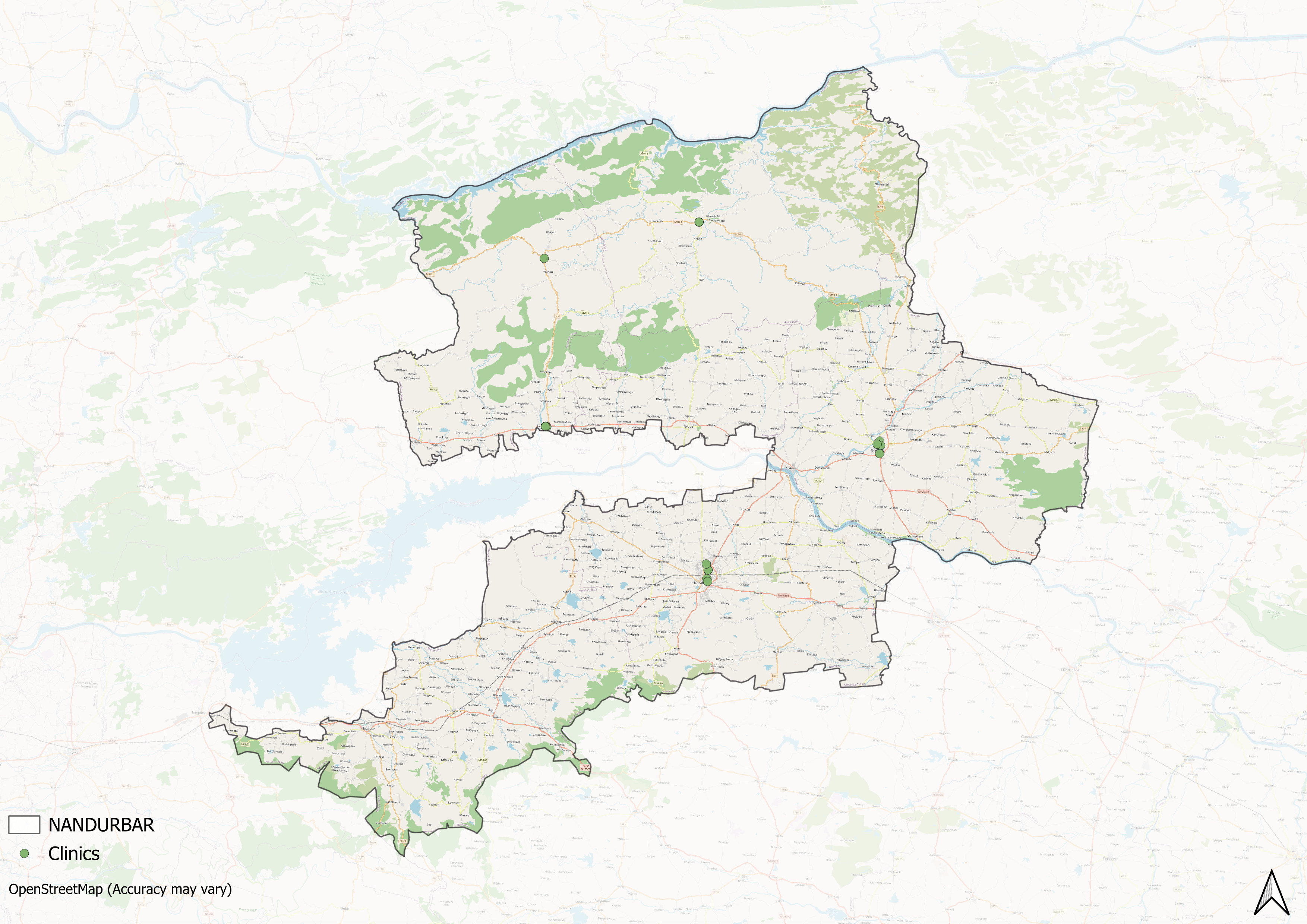
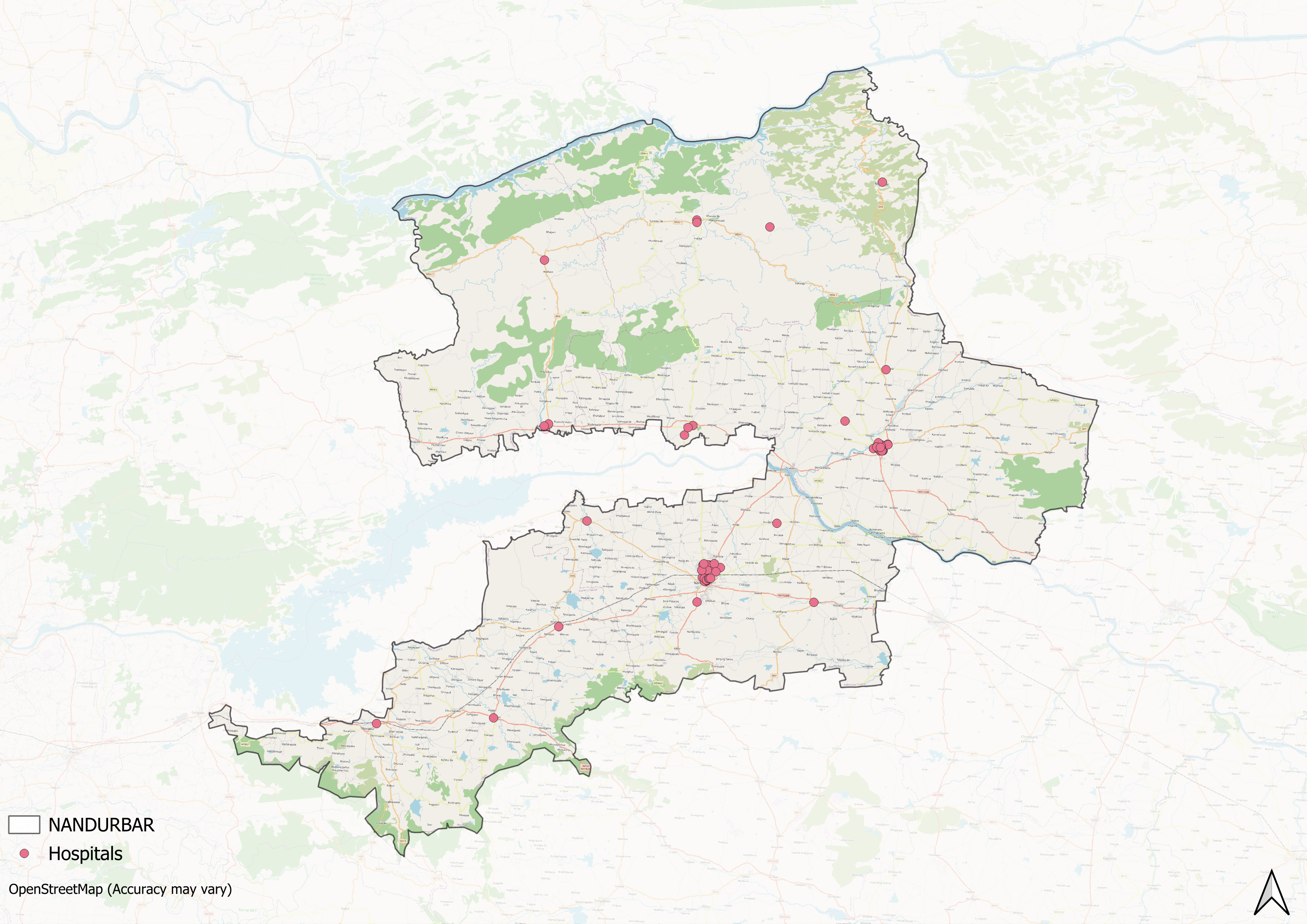
Supporting this structure is a network of Accredited Social Health Activists (ASHAs) who, as described by the National Health Mission, serve as “an interface between the community and the public health system.” Over time, this multi-layered healthcare model has been continuously shaped and refined by national healthcare policies and reforms, with the aim of improving service delivery and health outcomes across regions.
Medical Education & Research
Medical education and research form an integral part of Nandurbar’s healthcare landscape. As Mathew George (2023) highlights, medical institutions across India often serve a “dual purpose,” educating future healthcare professionals while providing medical services to local populations. Nandurbar reflects this pattern through a blend of systems, spanning allopathy, ayurveda, and Unani medicine, showcasing India’s pluralistic healthcare traditions.
A G Unani Medical College
One notable institution in the district is Jamia’s Ahmad Garib Unani Medical College. Established in 1997, it remains one of Maharashtra’s unique centres for Unani education. The college offers the Kamil-e-Tib-o-Jarahat (Bachelor of Unani Medicine and Surgery, B.U.M.S.) programme as prescribed by the Central Council of Indian Medicine (CCIM), New Delhi. The college is recognised by the Government of Maharashtra and affiliated with the Maharashtra University of Health Sciences (MUHS), Nashik.
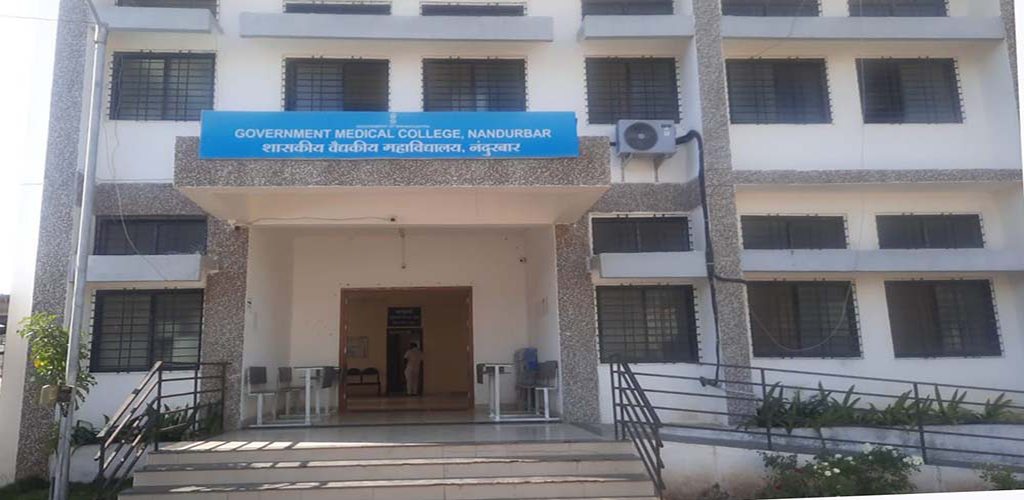
In 2020, the Government Medical College and Hospital (GMC Nandurbar) was set up as part of a state initiative to convert district hospitals into teaching hospitals. This marked an important step towards addressing gaps in medical training and healthcare services in this region.
Age Old Practices & Remedies
Before the rise of organised healthcare systems, communities in Nandurbar relied heavily on indigenous medicine. Local groups such as the Bhil, Pawra, and Gavit communities, especially in the Satpura Hill belt, have long preserved a deep understanding of traditional treatments passed down through generations. Local healers, often known as Bhagats, Vaidyas, or Vaidus, remain important figures for basic healthcare in remote villages.
Studies have documented various ethnomedicinal uses in the district. For example, locals prepare a paste from young saplings of Salai (Boswellia serrata) to treat eye infections such as conjunctivitis. Similarly, for epilepsy, root extracts from Mothi deni (Commelina benghalensis) are shaped into pills for medicinal use. These practices reflect a continued, though declining, reliance on traditional knowledge alongside allopathic systems.
NGOS & Initiatives
The determinants of health and health outcomes, as the World Health Organization (WHO) elaborates, are not solely shaped by more than just medical factors and healthcare services. The organization uses the term “social determinants of health (SDH)” to refer to the “non-medical factors that influence health outcomes.” These non-medical factors can be sanitation, nutrition, community well-being, or, as the WHO outlines, “income and social protection,” “food security,” access to quality healthcare, and more.
While there have been ongoing efforts to strengthen Nandurbar district’s healthcare infrastructure, certain areas still face challenges, particularly in addressing these broader health determinants. In response, non-governmental organizations have emerged as vital partners, working alongside public health systems to develop innovative, grassroots-level approaches that bridge these gaps.
Lakshya 84 Days
Lakshya 84 Days is a maternal and child health programme launched in Nandurbar district in 2023 to reduce high rates of infant and maternal mortality. The initiative divides care into two phases: 42 days of focused antenatal care (ANC) for pregnant women, followed by 42 days of postnatal care (PNC) for mothers and newborns. The programme aims to address key risk factors such as low birth weight, birth asphyxia, sepsis, respiratory illness, and complications linked to sickle cell disease, which is prevalent in the region.
This issue has deep historical roots, underscored by numerous Public Interest Litigations since 2007. In September 2022, the Bombay High Court summoned the District Collector to address the alarming rates of maternal and child fatalities, often attributed to malnutrition and inadequate healthcare services.
The launch of the programme came in response to a significant local health crisis. In 2023, the district civil hospital recorded 179 child deaths within three months. Historical concerns about maternal and child health in Nandurbar have been raised repeatedly since 2007, including through Public Interest Litigations. In September 2022, the Bombay High Court called on the District Collector to explain persistent deaths often attributed to malnutrition and gaps in healthcare delivery.
Nandurbar’s remote terrain and limited infrastructure make access to emergency care challenging, particularly at night. To overcome this, health centres have arranged transport for expectant mothers near delivery, and villagers often assist by carrying women in makeshift carriers to reach health facilities in time.
COVID Stories
In September 2020, Maharashtra was reported as the worst-affected state in India during the COVID-19 pandemic. The virus's spread in urban areas gradually reached the rural parts of the State, leading to widespread concern. The fear of COVID-19 resulted in the closure of many private healthcare facilities, including small hospitals and nursing homes in rural towns. Those that remained open were often hesitant to admit severely ill patients due to the prohibitive costs of treatment. Meanwhile, the public health system became overwhelmed, struggling to meet the needs of both COVID-19 and non-COVID patients.
Chinchpada Hospital
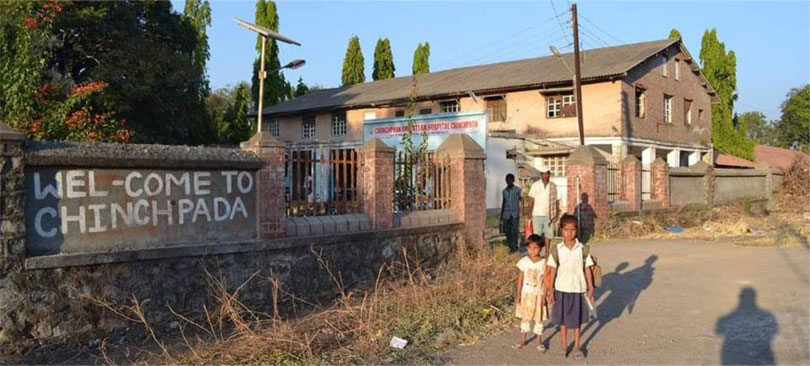
Among the few facilities to remain open in Nandurbar during this time was the Chinchpada Christian Hospital, which implemented strict infection control measures and continued providing care. Its reputation for affordable, patient-friendly services drew patients not just from Nandurbar but also from neighbouring districts like Dhule and Tapi. Recognising its capacity, district authorities designated it as a Dedicated COVID Health Centre (DCHC), expanding its role in managing moderate COVID-19 cases.
Nandurbar Model
By 2021, the Nandurbar Model for tackling COVID-19 gained attention for its effective strategies led by District Collector Rajendra Bharud. Despite widespread struggles for medical supplies, Nandurbar, a remote tribal district, managed to ensure accessibility for its underserved communities. Starting in September 2020, Bharud established oxygen plants in local hospitals, ensuring that when the second wave hit, Nandurbar had five operational plants, sufficient supplies, and ample hospital beds. The district transformed schools into quarantine centers for patients with mild symptoms, preventing delays in care.
As per BBC reports (2021), through this approach, Nandurbar increased its healthcare capacity to 148 critical care and 556 oxygen beds, and installed three oxygen plants capable of producing 4.8 million liters of oxygen daily. Additionally, the district acquired 30 oxygen concentrators for remote areas and trained "oxygen nurses" to optimize oxygen delivery. This proactive approach not only mitigated the pandemic's impact in Nandurbar but also served as a model for other districts in Maharashtra.
Graphs
Please Note
- Some line graphs may start a few years before the data begins. We are fixing this.
- All data comes in financial years, but is graphed below in calendar years (2015 in our graph means FY 2015-16).
- The District Statistical Abstracts are in Marathi. Translations were done carefully, but some titles or details may differ. There may be some data entry errors. Please report any issues you find.
- Sometimes districts without data may show empty graphs. We've removed them but let us know if any remain.
- Some graphs may not render correctly. A hard refresh (Ctrl/Command +Shift +R) usually fixes this.
Healthcare Facilities and Services
A. Public and Govt-Aided Medical Facilities
Loading chart data...
B. Private Healthcare Facilities
Loading chart data...
C. Approved vs Working Anganwadi
Loading chart data...
D. Anganwadi Building Types
Loading chart data...
E. Anganwadi Workers
Loading chart data...
F. Patients in In-Patients Department
Loading chart data...
G. Patients in Outpatients Department
Loading chart data...
H. Outpatient-to-Inpatient Ratio
Loading chart data...
I. Patients Treated in Public Facilities
Loading chart data...
J. Operations Conducted
Loading chart data...
K. Hysterectomies Performed
Loading chart data...
L. Share of Households with Access to Health Amenities
Loading chart data...
Morbidity and Mortality
A. Reported Deaths
Loading chart data...
B. Cause of Death
Loading chart data...
C. Reported Child and Infant Deaths
Loading chart data...
D. Reported Infant Deaths
Loading chart data...
E. Select Causes of Infant Death
Loading chart data...
F. Number of Children Diseased
Loading chart data...
G. Population with High Blood Sugar
Loading chart data...
H. Population with Very High Blood Sugar
Loading chart data...
I. Population with Mildly Elevated Blood Pressure
Loading chart data...
J. Population with Moderately or Severely High Hypertension
Loading chart data...
K. Women Examined for Cancer
Loading chart data...
L. Alcohol and Tobacco Consumption
Loading chart data...
Maternal and Newborn Health
A. Reported Deliveries
Loading chart data...
B. Institutional Births: Public vs Private
Loading chart data...
C. Home Births: Skilled vs Non-Skilled Attendants
Loading chart data...
D. Live Birth Rate
Loading chart data...
E. Still Birth Rate
Loading chart data...
F. Maternal Deaths
Loading chart data...
G. Registered Births
Loading chart data...
H. C-section Deliveries: Public vs Private
Loading chart data...
I. Institutional Deliveries through C-Section
Loading chart data...
J. Deliveries through C-Section: Public vs Private Facilities
Loading chart data...
K. Reported Abortions
Loading chart data...
L. Medical Terminations of Pregnancy: Public vs Private
Loading chart data...
M. MTPs in Public Institutions before and after 12 Weeks
Loading chart data...
N. Average Out of Pocket Expenditure per Delivery in Public Health Facilities
Loading chart data...
O. Registrations for Antenatal Care
Loading chart data...
P. Antenatal Care Registrations Done in First Trimester
Loading chart data...
Q. Iron Folic Acid Consumption Among Pregnant Women
Loading chart data...
R. Access to Postnatal Care from Health Personnel Within 2 Days of Delivery
Loading chart data...
S. Children Breastfed within One Hour of Birth
Loading chart data...
T. Children (6-23 months) Receiving an Adequate Diet
Loading chart data...
U. Sex Ratio at Birth
Loading chart data...
V. Births Registered with Civil Authority
Loading chart data...
W. Institutional Deliveries through C-section
Loading chart data...
X. C-section Deliveries: Public vs Private
Loading chart data...
Family Planning
A. Population Using Family Planning Methods
Loading chart data...
B. Usage Rate of Select Family Planning Methods
Loading chart data...
C. Sterilizations Conducted (Public vs Private Facilities)
Loading chart data...
D. Vasectomies
Loading chart data...
E. Tubectomies
Loading chart data...
F. Contraceptives Distributed
Loading chart data...
G. IUD Insertions: Public vs Private
Loading chart data...
H. Female Sterilization Rate
Loading chart data...
I. Women’s Unmet Need for Family Planning
Loading chart data...
J. Fertile Couples in Family Welfare Programs
Loading chart data...
K. Family Welfare Centers
Loading chart data...
L. Progress of Family Welfare Programs
Loading chart data...
Immunization
A. Vaccinations under the Maternal and Childcare Program
Loading chart data...
B. Infants Given the Oral Polio Vaccine
Loading chart data...
C. Infants Given the Bacillus Calmette Guerin (BCG) Vaccine
Loading chart data...
D. Infants Given Hepatitis Vaccine (Birth Dose)
Loading chart data...
E. Infants Given the Pentavalent Vaccines
Loading chart data...
F. Infants Given the Measles or Measles Rubella Vaccines
Loading chart data...
G. Infants Given the Rotavirus Vaccines
Loading chart data...
H. Fully Immunized Children
Loading chart data...
I. Adverse Effects of Immunization
Loading chart data...
J. Percentage of Children Fully Immunized
Loading chart data...
K. Vaccination Rate (Children Aged 12 to 23 months)
Loading chart data...
L. Children Primarily Vaccinated in (Public vs Private Health Facilities)
Loading chart data...
Nutrition
A. Children with Nutritional Deficits or Excess
Loading chart data...
B. Population Overweight or Obese
Loading chart data...
C. Population with Low BMI
Loading chart data...
D. Prevalence of Anaemia
Loading chart data...
E. Moderately Anaemic Women
Loading chart data...
F. Women with Severe Anaemia being Treated at an Institution
Loading chart data...
G. Malnourishment Among Infants in Anganwadis
Loading chart data...
Sources
Akshay Naik. 2020. "Resource Constraints Hamper Hospital in Remote Nandurbar District of Maharashtra." Moneylife India. www.moneylife.in/article/resource-constraints-hamper-hospital-in-remote-nandurbar-district-of-maharashtra/61500.htmlhttps://www.moneylife.in/article/resource-co…
ANI News. 2023. "Maharashtra: 179 Children Died in Civil Hospital at Nandurbar in Last Three Months." ANI News, India. www.aninews.in/news/national/general-news/maharashtra-179-children-died-in-civil-hospital-at-nandurbar-in-last-three-months20230916164237/https://www.aninews.in/news/national/general…
Ankur Gulabrao Umate Memorial Charitable Hospital: About Us. agumch.org/about-us/https://agumch.org/about-us/
BBC News. 2021. "Covid-19 in India: The Oxygen Crisis That Shook Maharashtra." BBC News. www.bbc.com/news/world-asia-india-57098621https://www.bbc.com/news/world-asia-india-57…
BioSpectrum India. 2024. "PM Sets Foundation for Revolutionary Healthcare Project in Nandurbar with ₹600 Cr Investment." BioSpectrum India. www.biospectrumindia.com/news/101/24254/pm-sets-foundation-for-revolutionary-healthcare-project-in-nandurbar-with-rs-600-cr-investment.htmlhttps://www.biospectrumindia.com/news/101/24…
Census of India. 2001. District Census Handbook: Nandurbar. Office of the Registrar General & Census Commissioner, India. censusindia.gov.in/nada/index.php/catalog/27805/download/30974/DH_27_2001_NAN.pdfhttps://censusindia.gov.in/nada/index.php/ca…
Chitrangada Choudhury. 2021. "How One Bureaucrat Ensured Enough Oxygen for His Remote Tribal District." Article 14. www.article-14.com/post/how-one-bureaucrat-ensured-enough-oxygen-for-his-remote-tribal-districthttps://www.article-14.com/post/how-one-bure…
Government Medical College, Nandurbar. "About GMC Nandurbar." GMC Nandurbar. gmcnandurbar.com/https://gmcnandurbar.com/
Jagtap, S. D., Deokule, S. S., Bhosle, S. V., & Pawar, S. G. 2006. "Some Unique Ethnomedicinal Uses of Plants Used by the Korku Tribe of Amravati District, Maharashtra, India." Vol. 5, no. 2. Natural Product Radiance. nopr.niscpr.res.in/bitstream/123456789/7988/1/Npr%205(2)%20125-130.pdfhttps://nopr.niscpr.res.in/bitstream/1234567…
M Choksi, B. Patil et al. 2016. Health systems in India. Vol 36 (Suppl 3). Journal of Perinatology. pmc.ncbi.nlm.nih.gov/articles/PMC5144115/https://pmc.ncbi.nlm.nih.gov/articles/PMC514…
Marianas Variety. 2023. "179 Children Dead in 3 Months: Mission Lakshya 84 Days Launched in Maharashtra’s Nandurbar." Marianas Variety.https://www.mvariety.com/news/regional_world/179-children-dead-in-3-months-mission-lakshya-84-days-launched-in-maharashtras-nandurbar/article_097ad0ce-5871-11ee-bd56-9b22b35a4b33.htmlhttps://www.mvariety.com/news/regional_world…
Mathew George. 2023. "The Real Purpose of the Medical College." The Hindu. www.thehindu.com/opinion/op-ed/the-real-purpose-of-the-medical-college/article67232008.ecehttps://www.thehindu.com/opinion/op-ed/the-r…
Mukhopadhyay, A. K., & Sharma, A. 2006. Animal-Origin Viral Zoonoses: Impact on Public Health and Biosafety. Springer, New York. www.google.co.in/books/edition/Animal_Origin_Viral_Zoonoses/1dX-DwAAQBAJ?hl=en&gbpv=1&dq=2006+H5N1+outbreak+in+India&pg=PA116&printsec=frontcoverhttps://www.google.co.in/books/edition/Anima…
National Health Mission (NHM), Government of India. 2025. "Community Health Officers and Their Role in Rural Healthcare." National Health Mission. nhm.gov.in/index1.php?lang=1&level=1&sublinkid=150&lid=226#:~:text=One%20of%20the%20key%20components,performing%20her%20spelled%20out%20roles.https://nhm.gov.in/index1.php?lang=1&level=1…
Patil, D. A. 2006. "Traditional Knowledge and Indigenous Practices of the Pawra Tribe of Nandurbar District, Maharashtra." Vol. 5, no. 3. Indian Journal of Traditional Knowledge. nopr.niscpr.res.in/bitstream/123456789/6915/1/IJTK%205%283%29%20%282006%29%20327-330.pdfhttps://nopr.niscpr.res.in/bitstream/1234567…
Rupsa Chakraborty. 2023. "Mission Lakshya: Nandurbar Home Deliveries Dip, Govt Concerned About Infant and Maternal Mortality." The Indian Express. indianexpress.com/article/cities/mumbai/mission-lakshya-nandurbar-home-deliveries-dip-govt-infant-maternal-mortality-9242281/https://indianexpress.com/article/cities/mum…
Shreya Bhandary. 2020. "New Medical College in Maharashtra’s Nandurbar to Make Way for Additional 100 MBBS Seats." Hindustan Times. www.hindustantimes.com/mumbai-news/new-medical-college-in-maharashtra-s-nandurbar-to-make-way-for-additional-100-mbbs-seats/story-KZTXIELCYnfInrTkDxSplL.htmlhttps://www.hindustantimes.com/mumbai-news/n…
The Times of India. 2024. "Diarrhoea Outbreak in Nandurbar Village: 28 Taken Ill." The Times of India. timesofindia.indiatimes.com/city/nashik/diarrhoea-outbreak-in-nandurbar-village-28-taken-ill/articleshow/113159027.cmshttps://timesofindia.indiatimes.com/city/nas…
Wikipedia. "2006 H5N1 Outbreak in India." Wikipedia, The Free Encyclopedia. en.wikipedia.org/wiki/2006_H5N1_outbreak_in_Indiahttps://en.wikipedia.org/wiki/2006_H5N1_outb…
World Health Organization (WHO). "Social Determinants of Health." World Health Organization. www.who.int/health-topics/social-determinants-of-health#tab=tab_1https://www.who.int/health-topics/social-det…
Last updated on 19 October 2026. Help us improve the information on this page by clicking on suggest edits or writing to us.