Contents
- Healthcare Infrastructure
- Three Tiered Structure in the District
- Medical Education & Research
- Age-Old Practices & Remedies
- Graphs
- Healthcare Facilities and Services
- A. Public and Govt-Aided Medical Facilities
- B. Private Healthcare Facilities
- C. Approved vs Working Anganwadi
- D. Anganwadi Building Types
- E. Anganwadi Workers
- F. Patients in In-Patients Department
- G. Patients in Outpatients Department
- H. Outpatient-to-Inpatient Ratio
- I. Patients Treated in Public Facilities
- J. Operations Conducted
- K. Hysterectomies Performed
- L. Share of Households with Access to Health Amenities
- Morbidity and Mortality
- A. Reported Deaths
- B. Cause of Death
- C. Reported Child and Infant Deaths
- D. Reported Infant Deaths
- E. Select Causes of Infant Death
- F. Number of Children Diseased
- G. Population with High Blood Sugar
- H. Population with Very High Blood Sugar
- I. Population with Mildly Elevated Blood Pressure
- J. Population with Moderately or Severely High Hypertension
- K. Women Examined for Cancer
- L. Alcohol and Tobacco Consumption
- Maternal and Newborn Health
- A. Reported Deliveries
- B. Institutional Births: Public vs Private
- C. Home Births: Skilled vs Non-Skilled Attendants
- D. Live Birth Rate
- E. Still Birth Rate
- F. Maternal Deaths
- G. Registered Births
- H. C-section Deliveries: Public vs Private
- I. Institutional Deliveries through C-Section
- J. Deliveries through C-Section: Public vs Private Facilities
- K. Reported Abortions
- L. Medical Terminations of Pregnancy: Public vs Private
- M. MTPs in Public Institutions before and after 12 Weeks
- N. Average Out of Pocket Expenditure per Delivery in Public Health Facilities
- O. Registrations for Antenatal Care
- P. Antenatal Care Registrations Done in First Trimester
- Q. Iron Folic Acid Consumption Among Pregnant Women
- R. Access to Postnatal Care from Health Personnel Within 2 Days of Delivery
- S. Children Breastfed within One Hour of Birth
- T. Children (6-23 months) Receiving an Adequate Diet
- U. Sex Ratio at Birth
- V. Births Registered with Civil Authority
- W. Institutional Deliveries through C-section
- X. C-section Deliveries: Public vs Private
- Family Planning
- A. Population Using Family Planning Methods
- B. Usage Rate of Select Family Planning Methods
- C. Sterilizations Conducted (Public vs Private Facilities)
- D. Vasectomies
- E. Tubectomies
- F. Contraceptives Distributed
- G. IUD Insertions: Public vs Private
- H. Female Sterilization Rate
- I. Women’s Unmet Need for Family Planning
- J. Fertile Couples in Family Welfare Programs
- K. Family Welfare Centers
- L. Progress of Family Welfare Programs
- Immunization
- A. Vaccinations under the Maternal and Childcare Program
- B. Infants Given the Oral Polio Vaccine
- C. Infants Given the Bacillus Calmette Guerin (BCG) Vaccine
- D. Infants Given Hepatitis Vaccine (Birth Dose)
- E. Infants Given the Pentavalent Vaccines
- F. Infants Given the Measles or Measles Rubella Vaccines
- G. Infants Given the Rotavirus Vaccines
- H. Fully Immunized Children
- I. Adverse Effects of Immunization
- J. Percentage of Children Fully Immunized
- K. Vaccination Rate (Children Aged 12 to 23 months)
- L. Children Primarily Vaccinated in (Public vs Private Health Facilities)
- Nutrition
- A. Children with Nutritional Deficits or Excess
- B. Population Overweight or Obese
- C. Population with Low BMI
- D. Prevalence of Anaemia
- E. Moderately Anaemic Women
- F. Women with Severe Anaemia being Treated at an Institution
- G. Malnourishment Among Infants in Anganwadis
- Sources
YAVATMAL
Health
Last updated on 19 October 2026. Help us improve the information on this page by clicking on suggest edits or writing to us.
Yavatmal’s healthcare landscape, like many other regions across India, is shaped by a mix of indigenous and Western medical practices. For centuries, communities in the district depended on local healers such as hakims and vaidyas, who treated illnesses using plants, herbs, and other resources found in the surrounding forests and fields. This use of local knowledge and natural remedies formed the base of early healthcare in Satara before formal hospitals were established. Over time, these practices continued alongside the introduction and expansion of more specialised medical services.
Healthcare Infrastructure
Similar to other regions in India, Yavatmal’s healthcare infrastructure follows a multi-tiered system that involves both public and private players. The public healthcare system is structured into primary, secondary, and tertiary levels. Primary care is provided through Sub Centres and Primary Health Centres (PHCs), secondary care is managed by Community Health Centres (CHCs) and Sub-District hospitals, while tertiary care, the highest level, is delivered through Medical Colleges and District Hospitals.
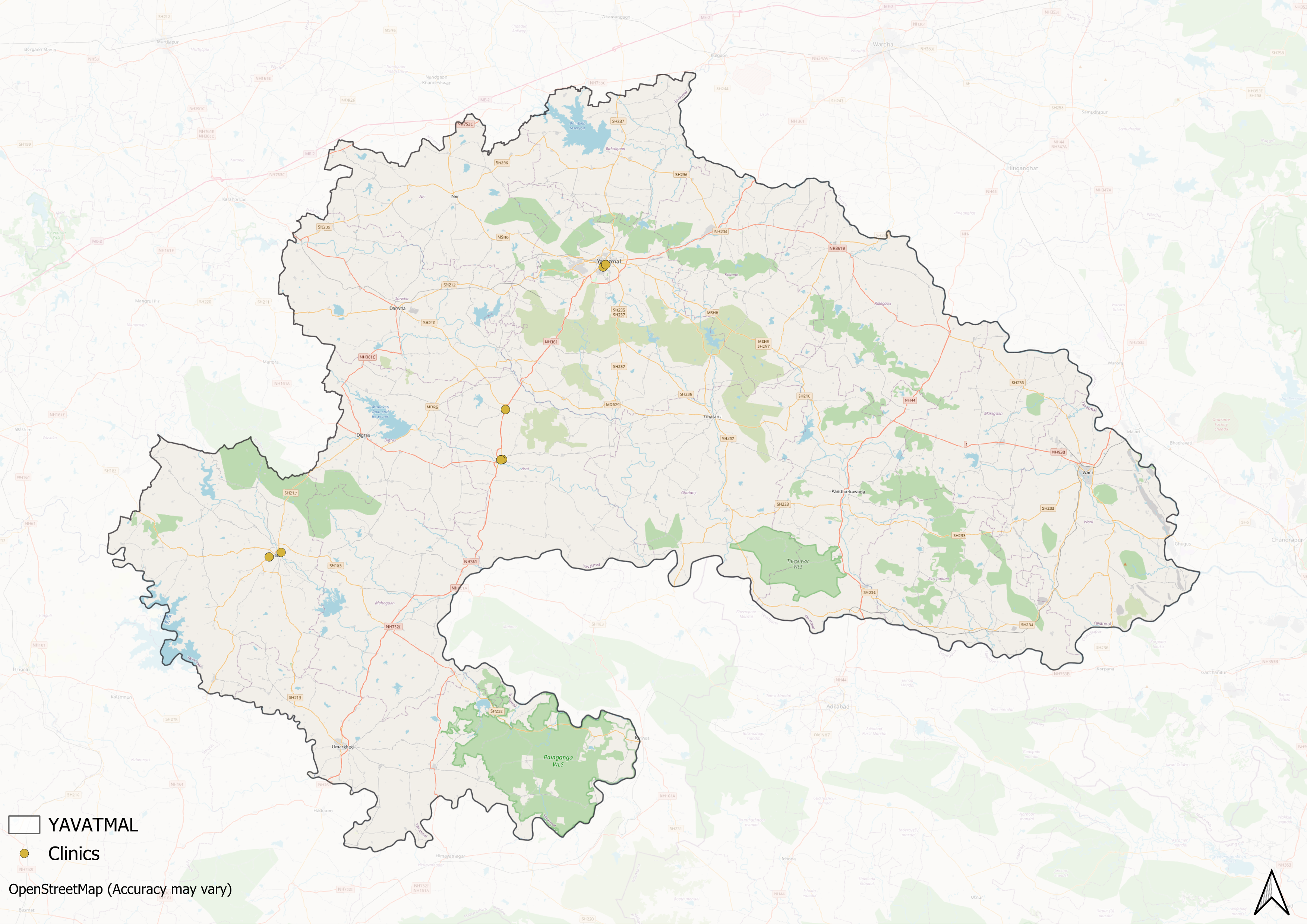
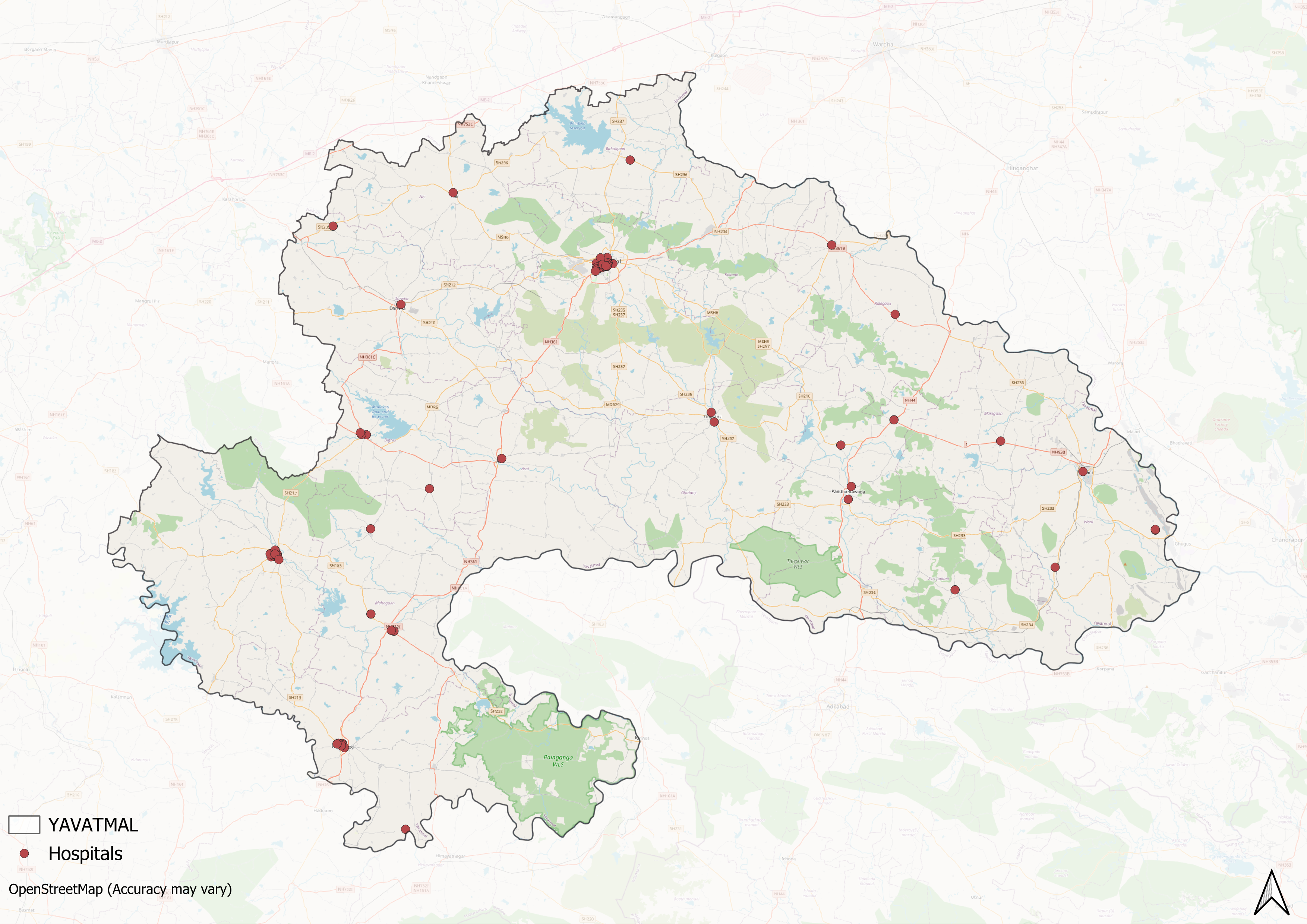
Supporting this structure is a network of Accredited Social Health Activists (ASHAs) who, as described by the National Health Mission, serve as “an interface between the community and the public health system.” Over time, this multi-layered healthcare model has been continuously shaped and refined by national healthcare policies and reforms, with the aim of improving service delivery and health outcomes across regions.
Three Tiered Structure in the District
Much of the district’s formal healthcare infrastructure took shape during the British Raj, which laid the base for primary and secondary care. It is noted in the district Gazetteer (1974) that, “in 1908, the district had ten hospitals and dispensaries with accommodation for indoor patients…all the dispensaries were established by the Government.”
This situation gradually began to change over time as the public system expanded, and by the 20th and 21st centuries, private hospitals also began to appear in Yavatmal, often established by local trusts, NGOs, and community initiatives. However, as in many parts of India, the spread of healthcare services has remained uneven across the district. A 2004 study noted “significant deficiencies in primary healthcare, especially in rural areas.” The district’s Programme Implementation Plan (2018) stated that there is no separate district hospital in Yavatmal, with the Government Medical College functioning as one of the main public facilities. Additionally at that time, there were three Sub-District Hospitals located at Pusad, Darwha, and Pandharkawada.
Medical Education & Research
Medical education and research are foundational to a district’s healthcare infrastructure. As Mathew Gerge aptly highlights, medical institutions often serve a “dual purpose,” which includes educating future healthcare professionals and providing healthcare services to the local population. In Yavatmal, this dual role is reflected in the presence of institutions that help address both the need for skilled healthcare workers and the ongoing demand for accessible medical care in the region.
Government Medical College
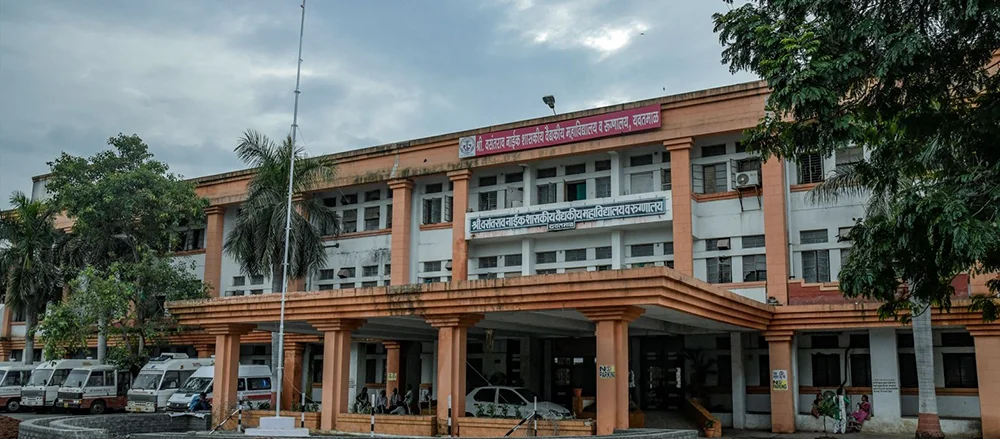
In the late 1980s, the Shri Vasant Rao Medical College was established to help meet the need for medical education facilities in the Vidarbha region. The college is affiliated with the Maharashtra University of Health Sciences (MUHS), which is based in Nashik.
Age-Old Practices & Remedies
Historically, before the advent of Western health care systems or the three-tiered healthcare infrastructure that exists today, people in the district relied on and made use of indigenous knowledge and medicine for their well-being. When it comes to healthcare, India, for long, has been characterized by a pluralistic health tradition. Among the many medicine systems that have a long history in India and in Yavatmal, as locals say, are Ayurveda and Unani. Alongside these established systems, numerous indigenous communities have developed and maintained their distinct medical practices across generations. What makes these medical systems particularly remarkable is how they have been shaped by their specific environmental contexts, cultural frameworks, and traditional beliefs.
The Kolam Community and Their Healing Traditions
Across India, numerous indigenous communities have developed unique medical systems, and one such community in Yavatmal are the Kolams. Originally from the Kolammal hills of South India, the Kolams have settled in regions like Yavatmal, Chandrapur, and Nanded in Maharashtra and are recognized as a Particularly Vulnerable Tribal Group (PVTG).
The community’s knowledge system is both ethnomedical and ritualistic. In a journal article, Dr. Gunjan Singh documents this practice, noting how the “Kolam tribe has been using plants, leaves, roots, mantras and rituals for healing for many hundreds of years.” Singh’s paper catalogs various herbs and practices utilized by the community. Among these is Bauhinia spp., known locally as Kaur or Kavid. The bark of this tree is commonly combined with other plant materials to prepare therapeutic remedies, particularly for treating jaundice, a practice that has been passed down through generations.
These medicinal preparations are prepared and administered by Kolam healers, who are the primary custodians of this knowledge. Notably, the training of Kolam healers follows a generally structured path and is attuned to local environments. In Yavatmal, for instance, Singh describes that “recognition of newly grown plants becomes easier after the rains,” and it is “during this time, the healers learn how to identify the parts of the plant to be used, the methods of usage, and the diseases they can treat.” The training period of the healers usually runs from Guru Purnima to Nag Panchami.
The learning process spans several years, typically beginning in childhood, and progresses from plant identification to medicine preparation for specific ailments. Interestingly, Singh notes that "in the Kolam tribe, it is believed that some medicinal plants lose their healing power if their names are spoken aloud or if their preparation methods are revealed." Because of this, many healers keep their knowledge closely guarded.
Religious and Cultural Practices
As mentioned above, the medical practices of the Kolam community are also ritualistic in nature. In some ways, then, their practices and understanding of illnesses intermingle with religion and folklore. Singh, explains in the study that, “the Kolam tribe believes that diseases occur only when the deities are displeased.” To prevent this from happening, each settlement of the community conducts “collective religious practices” throughout the year. As Singh notes, these rituals are meant “to prevent the entry of diseases into the Kolam settlement.”
The Pola month holds special significance in their healing traditions, as the community believes this is when colds, coughs, and fevers are most common. During this time, settlements come together to perform protective rituals centered around devi Mauli. The ceremony involves bathing Mauli with water infused with holy basil, turmeric, and neem leaves, before decorating her with coconuts and flowers. According to Singh, “then, the same water is distributed in front of the village square for everyone in the village to drink. This ritual is believed to ward off diseases.”
The connection between rituals and healing practices is common among ancient healing systems. The botanical knowledge and spiritual connections embedded in the medical traditions of the Kolams highlight that their approach to healing and healthcare is both holistic and deeply rooted in community. In 1996, the Royal Commission on Aboriginal Peoples (RCAP) described traditional healing as “practices designed to promote mental, physical and spiritual well being that are based on beliefs [,] which go back to the time before the spread of western scientific bio-medicine.” The traditions of the Kolams represents one such traditional healing system that exists in Yavatmal district.
Graphs
Please Note
- Some line graphs may start a few years before the data begins. We are fixing this.
- All data comes in financial years, but is graphed below in calendar years (2015 in our graph means FY 2015-16).
- The District Statistical Abstracts are in Marathi. Translations were done carefully, but some titles or details may differ. There may be some data entry errors. Please report any issues you find.
- Sometimes districts without data may show empty graphs. We've removed them but let us know if any remain.
- Some graphs may not render correctly. A hard refresh (Ctrl/Command +Shift +R) usually fixes this.
Healthcare Facilities and Services
A. Public and Govt-Aided Medical Facilities
Loading chart data...
B. Private Healthcare Facilities
Loading chart data...
C. Approved vs Working Anganwadi
Loading chart data...
D. Anganwadi Building Types
Loading chart data...
E. Anganwadi Workers
Loading chart data...
F. Patients in In-Patients Department
Loading chart data...
G. Patients in Outpatients Department
Loading chart data...
H. Outpatient-to-Inpatient Ratio
Loading chart data...
I. Patients Treated in Public Facilities
Loading chart data...
J. Operations Conducted
Loading chart data...
K. Hysterectomies Performed
Loading chart data...
L. Share of Households with Access to Health Amenities
Loading chart data...
Morbidity and Mortality
A. Reported Deaths
Loading chart data...
B. Cause of Death
Loading chart data...
C. Reported Child and Infant Deaths
Loading chart data...
D. Reported Infant Deaths
Loading chart data...
E. Select Causes of Infant Death
Loading chart data...
F. Number of Children Diseased
Loading chart data...
G. Population with High Blood Sugar
Loading chart data...
H. Population with Very High Blood Sugar
Loading chart data...
I. Population with Mildly Elevated Blood Pressure
Loading chart data...
J. Population with Moderately or Severely High Hypertension
Loading chart data...
K. Women Examined for Cancer
Loading chart data...
L. Alcohol and Tobacco Consumption
Loading chart data...
Maternal and Newborn Health
A. Reported Deliveries
Loading chart data...
B. Institutional Births: Public vs Private
Loading chart data...
C. Home Births: Skilled vs Non-Skilled Attendants
Loading chart data...
D. Live Birth Rate
Loading chart data...
E. Still Birth Rate
Loading chart data...
F. Maternal Deaths
Loading chart data...
G. Registered Births
Loading chart data...
H. C-section Deliveries: Public vs Private
Loading chart data...
I. Institutional Deliveries through C-Section
Loading chart data...
J. Deliveries through C-Section: Public vs Private Facilities
Loading chart data...
K. Reported Abortions
Loading chart data...
L. Medical Terminations of Pregnancy: Public vs Private
Loading chart data...
M. MTPs in Public Institutions before and after 12 Weeks
Loading chart data...
N. Average Out of Pocket Expenditure per Delivery in Public Health Facilities
Loading chart data...
O. Registrations for Antenatal Care
Loading chart data...
P. Antenatal Care Registrations Done in First Trimester
Loading chart data...
Q. Iron Folic Acid Consumption Among Pregnant Women
Loading chart data...
R. Access to Postnatal Care from Health Personnel Within 2 Days of Delivery
Loading chart data...
S. Children Breastfed within One Hour of Birth
Loading chart data...
T. Children (6-23 months) Receiving an Adequate Diet
Loading chart data...
U. Sex Ratio at Birth
Loading chart data...
V. Births Registered with Civil Authority
Loading chart data...
W. Institutional Deliveries through C-section
Loading chart data...
X. C-section Deliveries: Public vs Private
Loading chart data...
Family Planning
A. Population Using Family Planning Methods
Loading chart data...
B. Usage Rate of Select Family Planning Methods
Loading chart data...
C. Sterilizations Conducted (Public vs Private Facilities)
Loading chart data...
D. Vasectomies
Loading chart data...
E. Tubectomies
Loading chart data...
F. Contraceptives Distributed
Loading chart data...
G. IUD Insertions: Public vs Private
Loading chart data...
H. Female Sterilization Rate
Loading chart data...
I. Women’s Unmet Need for Family Planning
Loading chart data...
J. Fertile Couples in Family Welfare Programs
Loading chart data...
K. Family Welfare Centers
Loading chart data...
L. Progress of Family Welfare Programs
Loading chart data...
Immunization
A. Vaccinations under the Maternal and Childcare Program
Loading chart data...
B. Infants Given the Oral Polio Vaccine
Loading chart data...
C. Infants Given the Bacillus Calmette Guerin (BCG) Vaccine
Loading chart data...
D. Infants Given Hepatitis Vaccine (Birth Dose)
Loading chart data...
E. Infants Given the Pentavalent Vaccines
Loading chart data...
F. Infants Given the Measles or Measles Rubella Vaccines
Loading chart data...
G. Infants Given the Rotavirus Vaccines
Loading chart data...
H. Fully Immunized Children
Loading chart data...
I. Adverse Effects of Immunization
Loading chart data...
J. Percentage of Children Fully Immunized
Loading chart data...
K. Vaccination Rate (Children Aged 12 to 23 months)
Loading chart data...
L. Children Primarily Vaccinated in (Public vs Private Health Facilities)
Loading chart data...
Nutrition
A. Children with Nutritional Deficits or Excess
Loading chart data...
B. Population Overweight or Obese
Loading chart data...
C. Population with Low BMI
Loading chart data...
D. Prevalence of Anaemia
Loading chart data...
E. Moderately Anaemic Women
Loading chart data...
F. Women with Severe Anaemia being Treated at an Institution
Loading chart data...
G. Malnourishment Among Infants in Anganwadis
Loading chart data...
Sources
Gunjan Singh. 2024. Kolam tribe: Traditional healing practices (With special reference to Yavatmal district of Maharashtra). Vol. 7, No. 4.Shodhshauryam, International Scientific Refereed Research Journalhttps://doi.org/10.32628/SHISRJhttps://doi.org/10.32628/SHISRJ
https://pmc.ncbi.nlm.nih.gov/articles/PMC5144115/
J.A. Robbins, & J. Dewar. 2011. Traditional Indigenous approaches to healing and the modern welfare of traditional knowledge, spirituality, and lands: A critical reflection on practices and policies taken from the Canadian Indigenous example. Vol. 2, No. 4.The International Indigenous Policy Journalhttps://www.jstor.org/stable/48766968https://www.jstor.org/stable/48766968
M Choksi, B. Patil et al. 2016.Health systems in India.Vol 36 (Suppl 3).Journal of Perinatology.
M. Mishra, R. Duggal, & P. Raymus. 2004.Health and health care situation in Jalna, Yawatmal, and Nandurbar[Strategy paper]. Centre for Enquiry into Health and Allied Themes (CEHAT).https://www.researchgate.net/publication/268517697_HEALTH_AND_HEALTH_CARE_SITUATION_IN_JALNA_YAWATMAL_AND_NANDURBARhttps://www.researchgate.net/publication/268…
Maharashtra State Gazetteer Department. 1974. Yeotmal District. Yeotmal District Gazetteer. Gazetteer Department, Government of Maharashtra, Mumbai.
Mathew George. 2023.The real purpose of the medical college.The Hindu.https://www.thehindu.com/opinion/op-ed/the-real-purpose-of-the-medical-college/article67232008.ecehttps://www.thehindu.com/opinion/op-ed/the-r…
Last updated on 19 October 2026. Help us improve the information on this page by clicking on suggest edits or writing to us.